
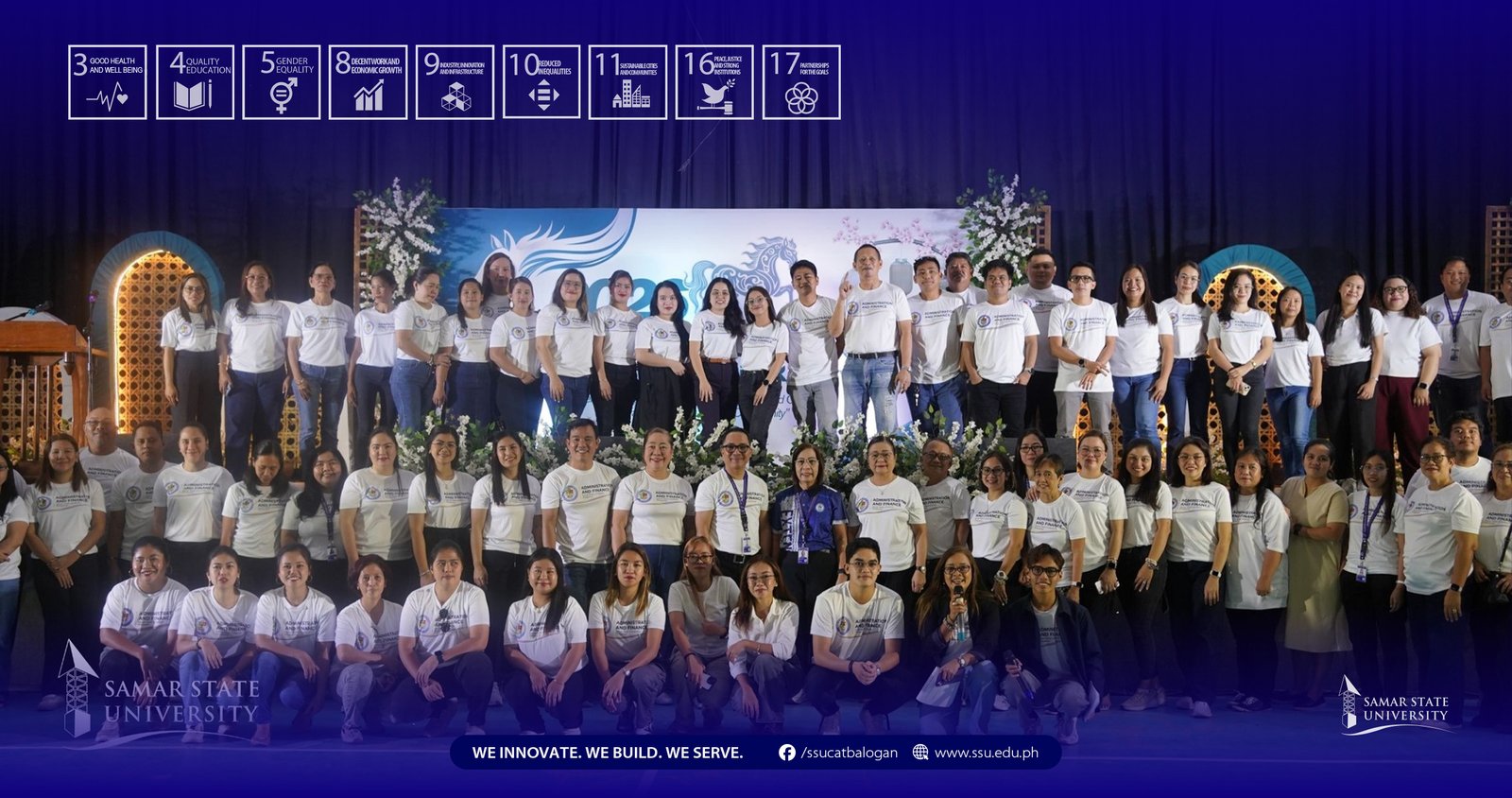
CATBALOGAN CITY, Philippines— The entire workforce of Samar State University (SSU) convened on January 30, 2026 for the year’s Kick-Off Meeting and Management Review, signaling a unified and energized start to the year under the theme “Neigh, Whinny, or Bray: Sounding and Galloping Towards an Enriched SSU Community.” The activity was hosted by the Office of the Vice President for Administration and Finance (OVPAF) and gathered faculty members, administrative personnel, researchers, and extensionists across all campuses.
The meeting served as a strategic platform to align the University’s academic, research, student services, administrative, and support functions with SSU’s vision for an enriched, future-ready academic community. University officials presented major priorities, directives, and strategic frameworks that will guide operations and performance for Fiscal Year 2026.
Along Academic Affairs
Vice President for Academic Affairs Dr. Gina Españo outlined the University’s academic direction under the F.U.T.U.R.E.S. framework—Flexible, Upholding quality, Trend-responsive, University expansion, Reach, Efficient governance, and Student-centered academic delivery. These priorities are strategically mirrored with CHED’s A.C.H.I.E.V.E. agenda, reinforcing SSU’s commitment to quality assurance, innovation, and global relevance.
Key directives include:
- Flexible & Smart Pedagogy (Deans, Campus Directors, and Faculty must institutionalize flexible learning modes (HyFlex, Blended, or Online), Digitize Instructional Materials (IMs) and syllabi, Upgrade “Model Smart Classroom”)
- Upholding Quality & Compliance (Certificate of Program Compliance (COPC), ISO and accreditation areas) Trend-Responsive & Gender-Inclusive Curriculum (Integrate Global Trends, SDG 5: Gender Equality, OBE compliance)
- University Expansion & Faculty (New programs, Faculty must pursue PhDs, Micro-credential programs)
- Reach & Global Visibility (New academic MOUs, Diverse gender representation in international delegations)
- Efficient Digital Governance (Update reporting templates, Online enrollment system and students’ kiosks)
- Student-Centered Academic Delivery (Anti-Sexual Harassment (ASH) Policy, Regular class schedule, Submission of grades, Student feedback framework)
Along Research, Development, and Extension Services
Vice President for Research and Extension Services Dr. Felisa Gomba presented SSU’s ten strategic objectives for research and extension, emphasizing the University continued strengthening of research excellence, innovation, and commercialization; build human capital through capacity development; promote evidence-based policy research; expand extension services for community empowerment; advance climate-resilient and health-focused research; and enhance ethical, gender-responsive, and efficient research governance systems.
- Advance Inclusive, Relevant, and Impact-Driven Research and Innovation for Sustainable Development: Generate and support multidisciplinary research responsive to national, regional development and local development priorities, aligned with the SSU Strategic Development Plan, Philippine Development Plan, Eastern Visayas Regional Development Plan, CHED-ACHIEVE, and the Sustainable Development Goals, particularly SDGs 1 (No Poverty), 4 (Quality Education), 8 (Decent Work and Economic Growth), and 10 (Reduced Inequalities).
- Strengthen Research Excellence, Innovation, and Knowledge Creation: Promote high-quality, ethical, and innovative research that advances science and technology for commercialization, supports regional competitiveness, and contributes to industrialization and digital transformation, consistent with PDP economic transformation goals, CHED-ACHIEVE’s innovation thrust, and SDG 9 (Industry, Innovation, and Infrastructure).
- Enhance Research and Extension Capacity and Human Capital Development: Build the competencies of faculty, researchers, staff, and students through capacity-building programs, mentorship, and improved research infrastructure, supporting CHED-ACHIEVE’s human capital development agenda- “A”, SSU’s strategic goals, and SDG 4 (Quality Education).
- Promote Research that Supports Evidence-Based Policy, Governance, and Institutional Development: Encourage policy-oriented and applied research that informs decision-making, strengthens public institutions, and supports good governance at the local, regional, and national levels, aligned with PDP governance reforms, CHED-ACHIEVE- “I”EV-RDP priorities, and SDG 16 (Peace, Justice, and Strong Institutions).
- Strengthen Extension Services thru creation of Extension Advisory Extension Program for Community Empowerment, regional development and national development: Translate research outputs into inclusive, responsive, and sustainable extension programs that empower communities, local government units, and key sectors in Samar and Eastern Visayas, supporting PDP and EV-RDP social development goals, SSU’s community engagement mandate, and SDGs 1, 11 (Sustainable Cities and Communities), and 17 (Partnerships for the Goals).
- Advance Climate-Resilient, Environmentally Sustainable, and Disaster-Responsive Research: Prioritize research addressing climate change adaptation, disaster risk reduction, environmental protection, and sustainable natural resource management, in line with PDP environmental sustainability objectives, EV-RDP resilience strategies, and SDGs 13 (Climate Action), 14 (Life Below Water), and 15 (Life on Land).
- Support Health, Well-being, and Social Innovation Research: Promote interdisciplinary research that improves health outcomes, food security, education, and social protection, particularly for vulnerable and marginalized populations in Samar and Eastern Visayas, aligned with PDP social protection priorities, CHED-ACHIEVE, and SDG 3 (Good Health and Well-being).
- Expand Strategic Partnerships and Collaborative Research Networks: Strengthen local, national, and international partnerships with government agencies, industry, civil society, and academic institutions to enhance resource mobilization, technology transfer, and collaborative innovation, consistent with CHED-ACHIEVE, SSU’s partnership goals, and SDG 17 (Partnerships for the Goals).
- Ensure Ethical, Responsible, and Quality Research and Extension Governance: Uphold ethical standards, research integrity, gender responsiveness, and regulatory compliance to ensure credibility, accountability, and societal trust in research and extension services, aligned with CHED quality assurance policies and PDP institutional strengthening goals.
- Enhance Research and Extension Management Systems and Institutional Efficiency: Improve policies, digital systems, monitoring and evaluation mechanisms, impact assessment and support services to ensure efficient, transparent, and accountable management of research and extension programs, supporting SSU’s strategic priorities and PDP institutional resilience agenda.
Along Student Affairs and Services
Vice President for Student Affairs and Services Engr. Ma. Lourdes Amante detailed a comprehensive slate of programs centered on student welfare, development, and holistic formation. These include strengthened student scholarship and welfare programs, enhanced internship and industry partnerships, sports development and talent recruitment, arts and cultural heritage initiatives, alumni relations and career readiness programs, and campus-specific student development and wellness services.
Across SSU campuses, initiatives will focus on mental health, gender equality, legal awareness, health surveillance, student leadership, cultural engagement, and inclusive care and wellness services that ensure support to students’ academic journeys inside and outside the classroom.
Along Administration & Finance
Vice President for Administration and Finance Engr. Mirador Labrador presented five strategic pillars guiding administrative and financial operations:
Strategic Pillar 1: Integrity and Compliance (Through this pillar, we aim to foster a culture of transparency, accountability, and audit readiness – providing a strong governance foundation for all other strategic initiatives)
Strategic Pillar 2: Efficiency and System Strengthening (Through this pillar, we aim to strengthen systems that are not only compliant, but also efficient and service-oriented)
Strategic Pillar 3: Financial Stewardship and Resource Optimization (Through this pillar, we reinforce our commitment to responsible financial management that sustains the University’s operations today while preparing it for future challenges)
Strategic Pillar 4: People-Centered Administration and Capacity Development (By investing in our people, we strengthen the foundation upon which effective governance, efficient systems, and sound financial management depend)
Strategic Pillar 5: Digitization and Data-Informed Management (Though this pillar, we aim to build administrative and financial systems that are not only compliant and efficient, but also forward-looking and responsive to the university’s future needs)
OVPAF’s commitment and way forward ensures a firm but fair governance anchored on law and policy; efficient, responsive, and coordinated administrative systems; responsible stewardship of public resources; supportive and people-centered administrative leadership; and gradual and sustainable digital transformation.
Along Planning, Gender and Development, Internationalization, and Quality Assurance
Planning Management Officer Dr. Rodrigo Estrada emphasized SSU’s FY 2026 strategic direction, anchored on community impact, alignment with global and national priorities, fiscal realism, land feasibility, and institutional risk reduction.
Gender and Development initiatives were presented by SAGWAN Director Dir. Charmaine Quina, highlighting gender mainstreaming, gender-responsive instruction, research, infrastructure, administration, and extension services. Major undertakings include capacity building, policy integration, GAD data systems, national advocacy campaigns, and the proposed establishment of KASANGA, SSU’s localized chapter of the MOVE initiative advocating men’s involvement in ending violence against women.
Internationalization priorities were discussed by Dr. Elmer Irene, Director of the Office of International Affairs, focusing on faculty and student mobility, international student recruitment, global rankings participation, research collaboration, and alignment with CHED’s ACHIEVE internationalization thrusts.
Meanwhile, Dir. Jake Boy Carbonquillo of the University Quality Assurance Office outlined key directives aimed at transitioning to global standards, pursuing institutional and program accreditation, achieving zero-liability compliance through full COPC coverage, identifying niche programs for COE/COD status, and adopting proactive, smart monitoring systems.
Galloping Forward Together
With shared purpose and collective resolve, the 2026 Kick-Off Meeting reaffirmed SSU’s strengthened unity and sharpened direction. As the University moves forward, its leadership and workforce stand committed to galloping together toward a more inclusive, innovative, and enriched SSU community for FY 2026 and beyond.